📋 Table of Contents
Why the Wrangler Is the Overland Icon
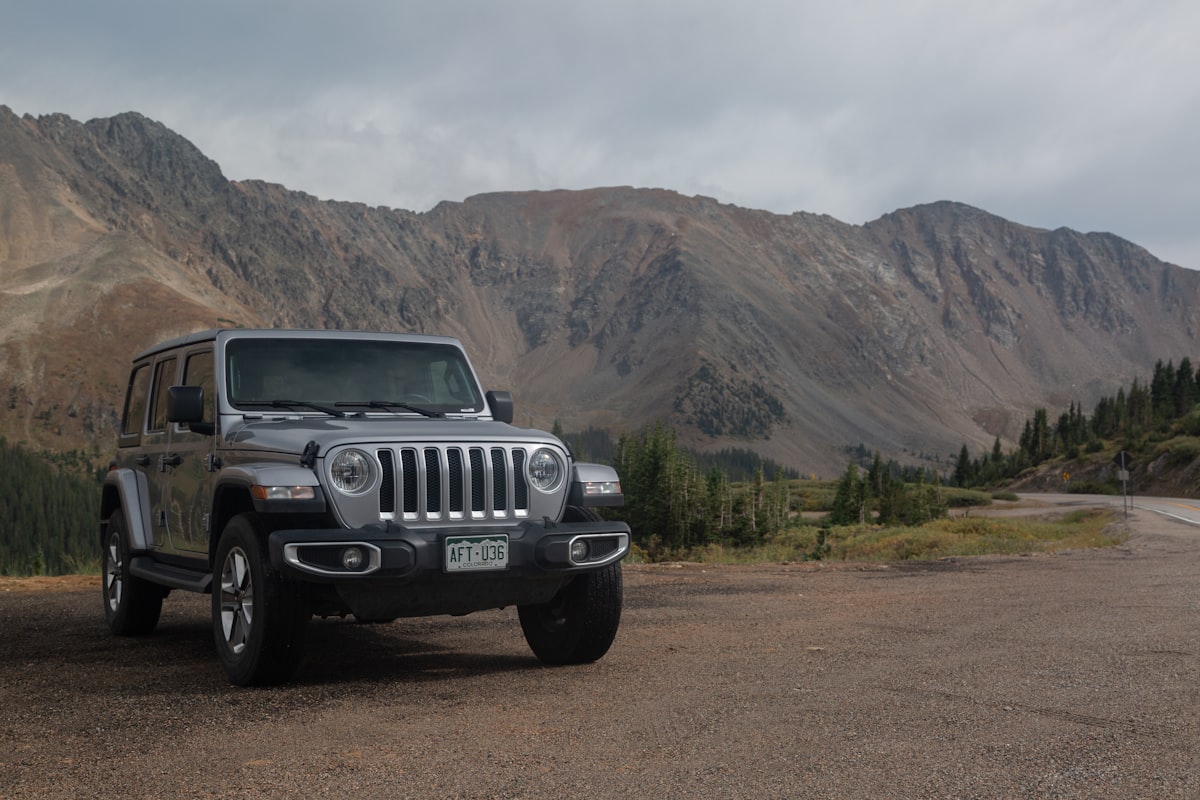
No vehicle defines overlanding culture like the Jeep Wrangler. It's been going places it has no business going since 1941, and it hasn't stopped. The Wrangler's combination of solid front and rear axles, short wheelbase, high ground clearance, and a modular design that's been purpose-built for modification for over 80 years makes it unlike anything else on the market.
The aftermarket ecosystem around the Wrangler is, frankly, absurd in the best possible way. You can find a bolt-on solution for virtually any modification you want to make — most of it designed, manufactured, and tested by companies that have been building Jeep parts since before some overlanders were born. Want to swap axles? There's a kit. Run 40-inch tires? There's a kit. Install an onboard air system that also controls lockers? Yep, kit.
That ecosystem comes with a flip side: it's easy to spend enormous amounts of money modifying a Wrangler without making it meaningfully more capable than a well-spec'd stock Rubicon. This guide cuts through that noise and tells you what actually moves the needle — at three budget levels designed to produce real, trail-tested results.
What Makes the Wrangler Different
Before diving into the builds, it's worth understanding what makes the Wrangler uniquely suited — and occasionally uniquely challenging — as an overland platform.
Solid axles front and rear: Unlike virtually every other modern vehicle in the segment, the Wrangler runs solid beam axles on both ends. This means the suspension geometry stays consistent through full articulation, lift doesn't introduce CV angle problems, and axle repairs on the trail are straightforward. It also means the on-road handling is distinctly trucky compared to an independent-front-suspension platform like the Tacoma or 4Runner.
Factory locker availability: The Rubicon trim comes with Dana 44 axles and electronic lockers front and rear from the factory. This is extraordinary capability that typically costs $2,000–$4,000 to add to a vehicle that doesn't have it. If serious off-road performance is your goal, a Rubicon as a starting point is often the most cost-effective path.
Fold-down windshield and removable doors/top: The Wrangler's party trick. Full open-air driving, unobstructed views for photography and navigation, and a connection to terrain that no other vehicle provides. For overlanders who value the experience as much as the destination, this feature is genuinely irreplaceable.
Dana axle options: JK Wranglers (2007–2018) come with Dana 30/44 (Sport, Sahara) or Dana 44/44 (Rubicon) axles. JL Wranglers (2018–present) get Dana 30/35 (Sport), Dana 44/44 (Sahara, Sport S), or Dana 44 front / Dana 44 AdvanTEK rear (Rubicon). For serious wheeling, the Rubicon's Dana 44s are far preferable to the lighter 30/35 axles.
The $4k Build — Capable Daily
This build makes a stock Wrangler genuinely trail-capable without any drivetrain work. The focus is lift, tires, a front bumper with winch, and protection. Total investment: approximately $3,600.
Lift: Teraflex or Rough Country 2" Leveling Kit
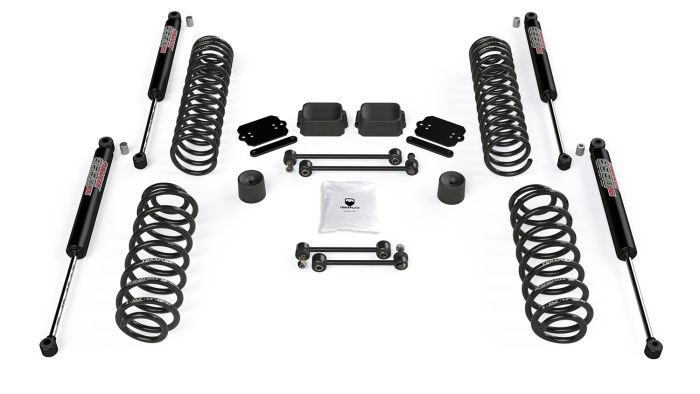
Teraflex 2" Suspension Lift Kit — JK or JL
Why We Like It
- 2" of lift clears 35" tires with minor trimming on most JK/JL trims
- Teraflex geometry is properly engineered — no bump steer at this lift height
- Coil spacer design retains factory shocks (upgrade later as budget allows)
- Bolt-on installation with basic hand tools in 4–6 hours
- Teraflex's JL version adjusts for the front track bar geometry
At this budget tier, a coil spacer lift gets you 35" tire clearance without the cost of a full coilover system. The Teraflex kit is properly engineered — not just spacers thrown on an otherwise stock suspension. For budget-conscious builders, Rough Country's 2.5" lift (~$350) is an alternative that includes new shocks, though Teraflex has better long-term reputation for geometry and durability.
Tires: 285/70R17 Falken Wildpeak MT01
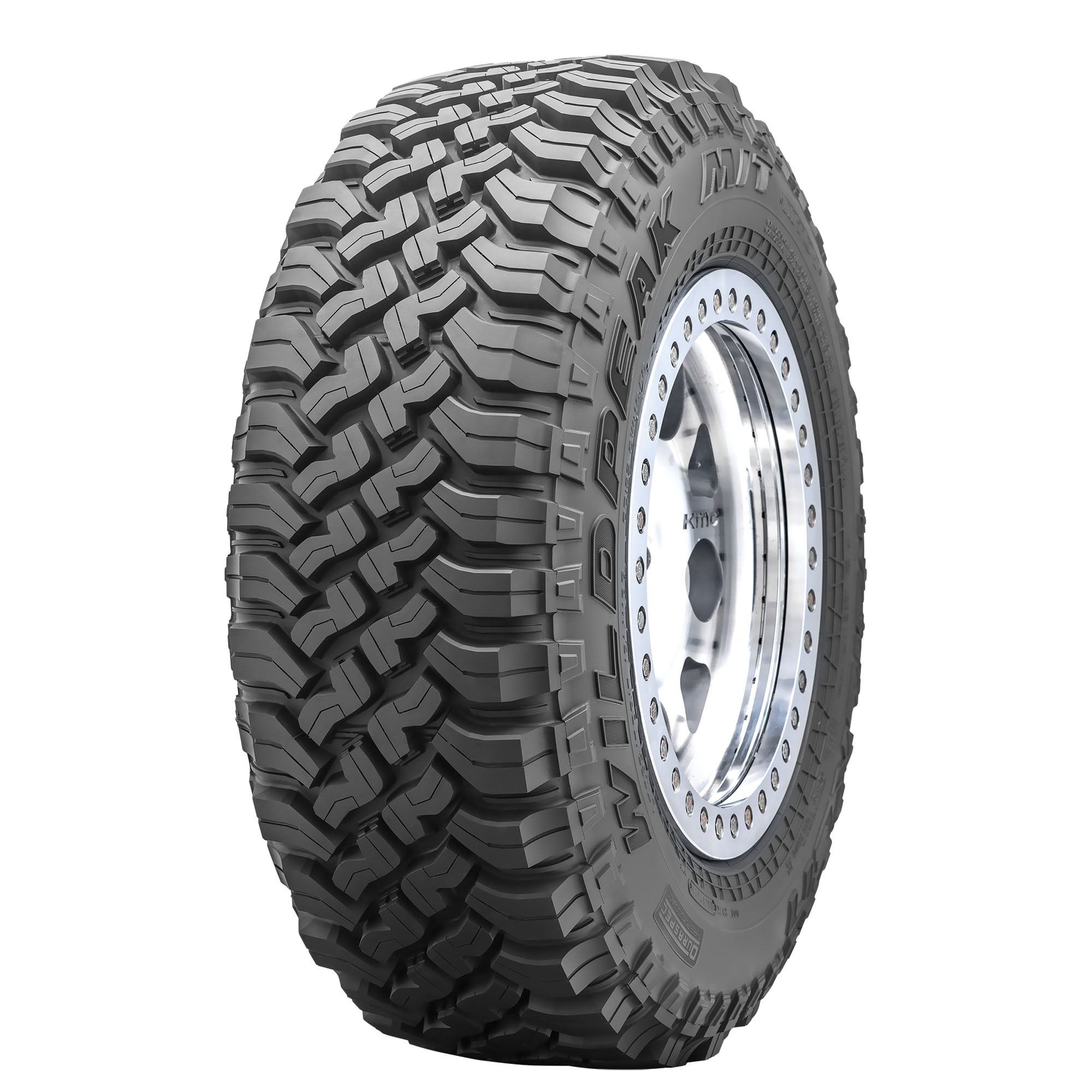
Falken Wildpeak MT01 — 285/70R17 (Set of 4)
Why We Like It
- Aggressive mud-terrain tread without MaxTrax-level highway drone
- 3-ply sidewall resists punctures on rocky terrain
- Excellent wet performance for a mud-terrain compound
- Fits 17" factory JL wheels without modification
- Lower price than BFG KM3 at comparable performance
Front Bumper: Smittybilt XRC
The Smittybilt XRC front bumper (~$700) is the best value steel winch bumper in the Wrangler market. It provides proper recovery points, a D-ring mount on each end, and a winch plate — all from 3/16" steel with a textured black powder coat finish. It's not as refined as Poison Spyder or ARB, but it's a serious piece of steel at a fraction of the price.
Check Smittybilt XRC Bumper on Amazon ↗Winch: Warn VR EVO 10-S
Mount a Warn VR EVO 10-S (~$950) in the XRC bumper for a complete front recovery setup. This winch is appropriately sized for a Wrangler — 10,000 lb line pull on synthetic rope, series-wound motor, and Warn's reputation for reliability. Add Rough Country rock sliders (~$500) for rocker protection, basic recovery gear (~$300), and pod lights (~$150) and you have a highly capable daily that can handle any maintained trail.
Check Warn VR EVO 10-S on Amazon ↗Tier 1 Total: ~$3,600 — Teraflex lift ($957) + Falken MT tires ($1,440) + Smittybilt bumper ($700) + Warn winch ($950) + rock sliders ($500) + recovery gear ($300) + pod lights ($150).
The $10k Build — Trail Warrior
This is where the Wrangler gets serious. Proper lift with Fox shocks, 35" BFGs, a quality bumper, compressed air, and a rooftop tent. This build can handle the Rubicon Trail loaded with a week of gear. Total investment: approximately $9,500.
Suspension: Teraflex 3.5" with Fox 2.0 Shocks
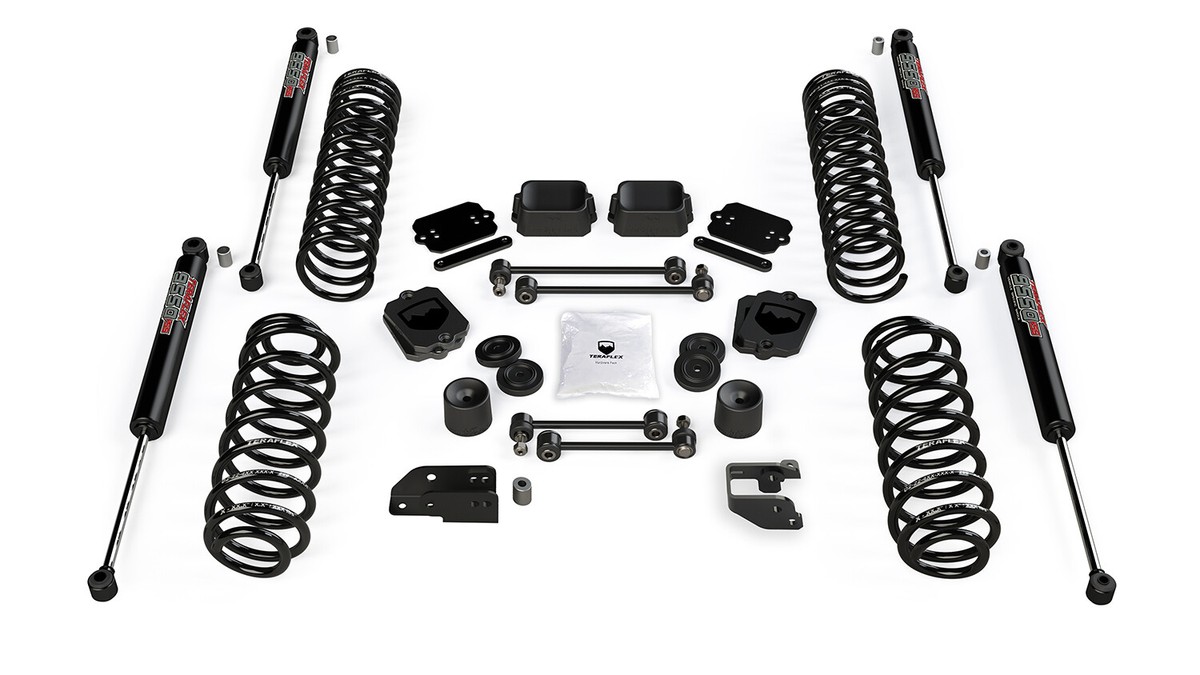
Teraflex 3.5" Lift Kit with Fox 2.0 Performance Shocks — JL
Why We Like It
- 3.5" lift clears 35" tires with no rubbing and no trimming required
- Fox 2.0 shocks provide a legitimate performance upgrade from stock
- Kit includes front track bar bracket for corrected geometry
- Complete system — no mixing and matching aftermarket components
- Handles 35" or 37" tires (37s may need minor upper fender trimming)
Bumper: Poison Spyder Brawler
The Poison Spyder Brawler front bumper (~$1,400) is a step up in quality and fitment from the Smittybilt XRC. The steel is heavier gauge, the recovery points are better positioned, and the design looks purpose-built rather than generic. Pair it with a Warn ZEON 10-S winch (~$1,100) — the ZEON is Warn's mid-tier line, with a better motor and faster line speed than the VR EVO.
Check Poison Spyder Bumper on Amazon ↗Recovery & Air: TRED Pro + ARB Twin Compressor
Budget $489 for an ARB Twin air compressor — it inflates all four tires to road pressure in under 10 minutes and provides the air supply for lockers if you add them later. Add a set of TRED Pro recovery boards (~$219) and a Bubba Rope recovery kit (~$150) for a complete recovery loadout.
Check ARB Twin Compressor on Amazon ↗Sleep: iKamper Skycamp Mini RTT
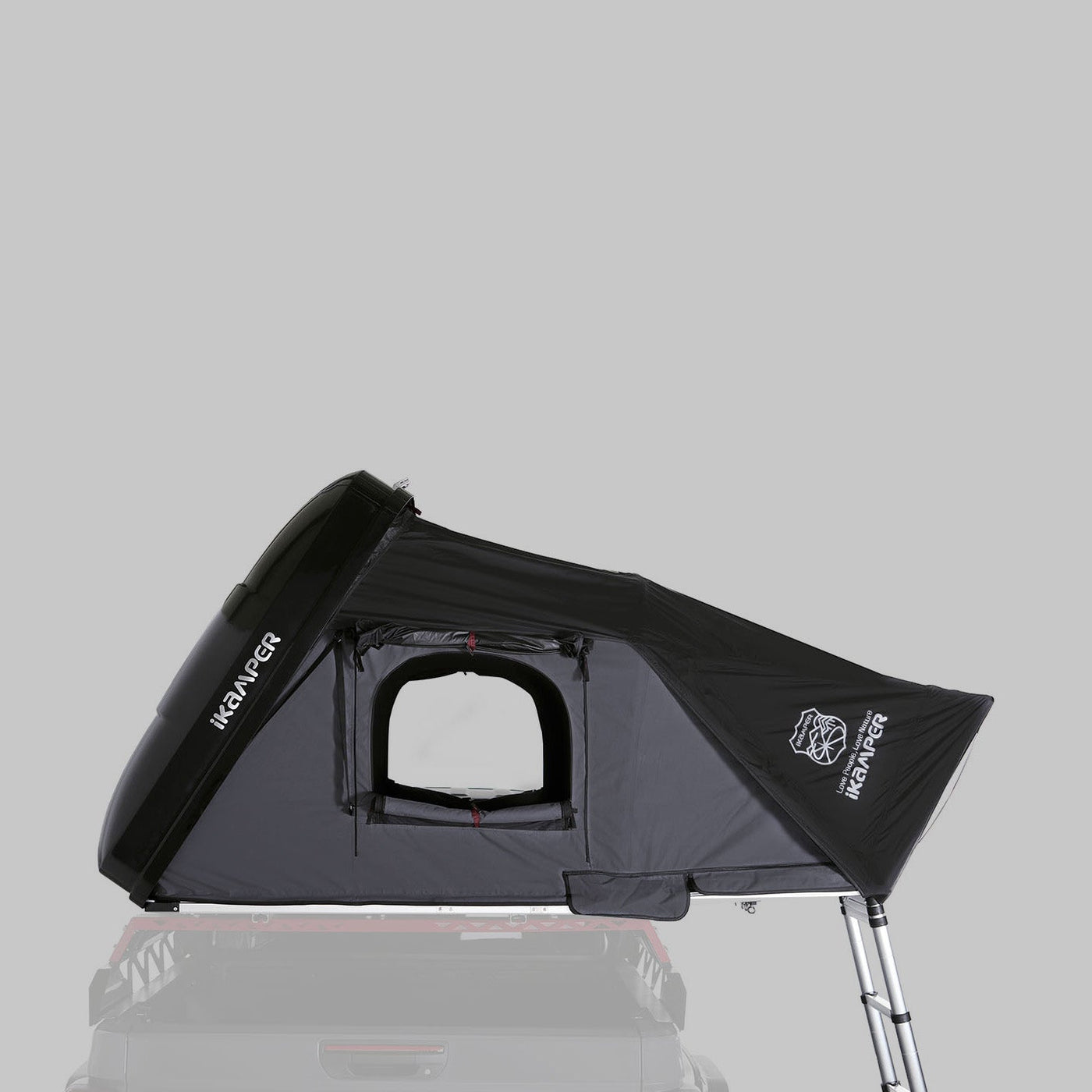
iKamper Skycamp Mini Rooftop Tent
Why We Like It
- Compact hard-shell design sized for Wrangler roof racks
- Opens in 60 seconds flat — genuine 1-person operation
- Thermoplastic hard shell handles aggressive weather
- Fits one adult comfortably (tight for two)
- Low-profile closed height plays well with Wrangler's aero limits
The Skycamp Mini mounts to a Gobi or Smittybilt roof rack on the Wrangler. On a JL 4-door, the roof rack gives you enough mounting real estate for the tent plus a solar panel. GenRight or Rugged Ridge sliders (~$700) replace the Rough Country units from Tier 1 with heavier steel and better mounting geometry.
Tier 2 Total: ~$9,500 — Teraflex lift with Fox shocks ($2,200) + 35" BFG KO2 or MT ($1,000) + Poison Spyder bumper ($1,400) + Warn ZEON 10-S ($1,100) + GenRight sliders ($700) + ARB twin compressor ($489) + TRED Pro + rope ($369) + iKamper Skycamp Mini ($1,169).
The $25k Build — Expedition Wrangler
This is the Wrangler that doesn't turn around. Full lockers, 37" tires on proper wheels, belly armor from front to rear, hard-shell RTT, cold fridge, and a solar/lithium system that keeps you out indefinitely. Total investment: $22,000–$26,000.
Suspension: Synergy Manufacturing 4" System
Synergy's 4" suspension system (~$3,000) includes coil springs, adjustable control arms, and geometry correction components for the JL platform. At 4" of lift you're running 37" tires without any fitment compromises, and the adjustable control arms let you dial in caster and pinion angle precisely. This is a professional-grade installation — budget for shop labor if you're not an experienced mechanic.
Check Synergy Suspension on Amazon ↗Tires: 37" BFG KM3 on Method Wheels
The BFGoodrich Mud-Terrain T/A KM3 in 37x12.50R17 (~$400/each, so $1,600 for four) paired with Method Race Wheels 105 Beadlocks (~$200/wheel, $800 for four) totals approximately $2,400. The KM3 is the definitive expedition mud-terrain tire — the compound grips in conditions that defeat lesser tires, the 3-ply sidewall handles rock abuse, and BFG's support network means replacement tires are available virtually everywhere.
Check BFG KM3 37" Tires on Amazon ↗Lockers: ARB Air Lockers Front + Rear
On a non-Rubicon Wrangler, ARB air lockers front and rear plus their compressor system runs approximately $3,000 installed. On a Rubicon, this budget covers electronic locker upgrades or is redirected to other systems. The difference between an open-diff Wrangler and one with lockers front and rear on technical terrain is night and day — this is the single most impactful capability upgrade available.
Check ARB Air Lockers on Amazon ↗Armor: Full AEV or GenRight Belly Skid System
A full belly skid system (gas tank, transfer case, and transmission skids) from AEV or GenRight runs approximately $2,000. These bolt-on systems protect the Wrangler's most vulnerable underbody components from rock strikes. At this build tier, full protection isn't optional — you're going to hit things, and the armor pays for itself the first time you drag across a ledge without punching a hole in the gas tank.
Check Wrangler Skid Plates on Amazon ↗Bumpers: AEV or Expedition One Front + Rear Pair
AEV's Tucson and Pintler bumpers, or Expedition One's comparable options, run approximately $3,000 for a front/rear pair. These are premium bumpers with proper D-ring mounts, hi-lift jack points, and a fit and finish that matches the JL's factory body lines. The rear bumper provides tire carrier mounting for a full-size spare — essential when running 37s that won't fit in the factory location.
Check AEV Bumpers on Amazon ↗Sleep & Camp: CVT Sandstorm Hard Shell RTT
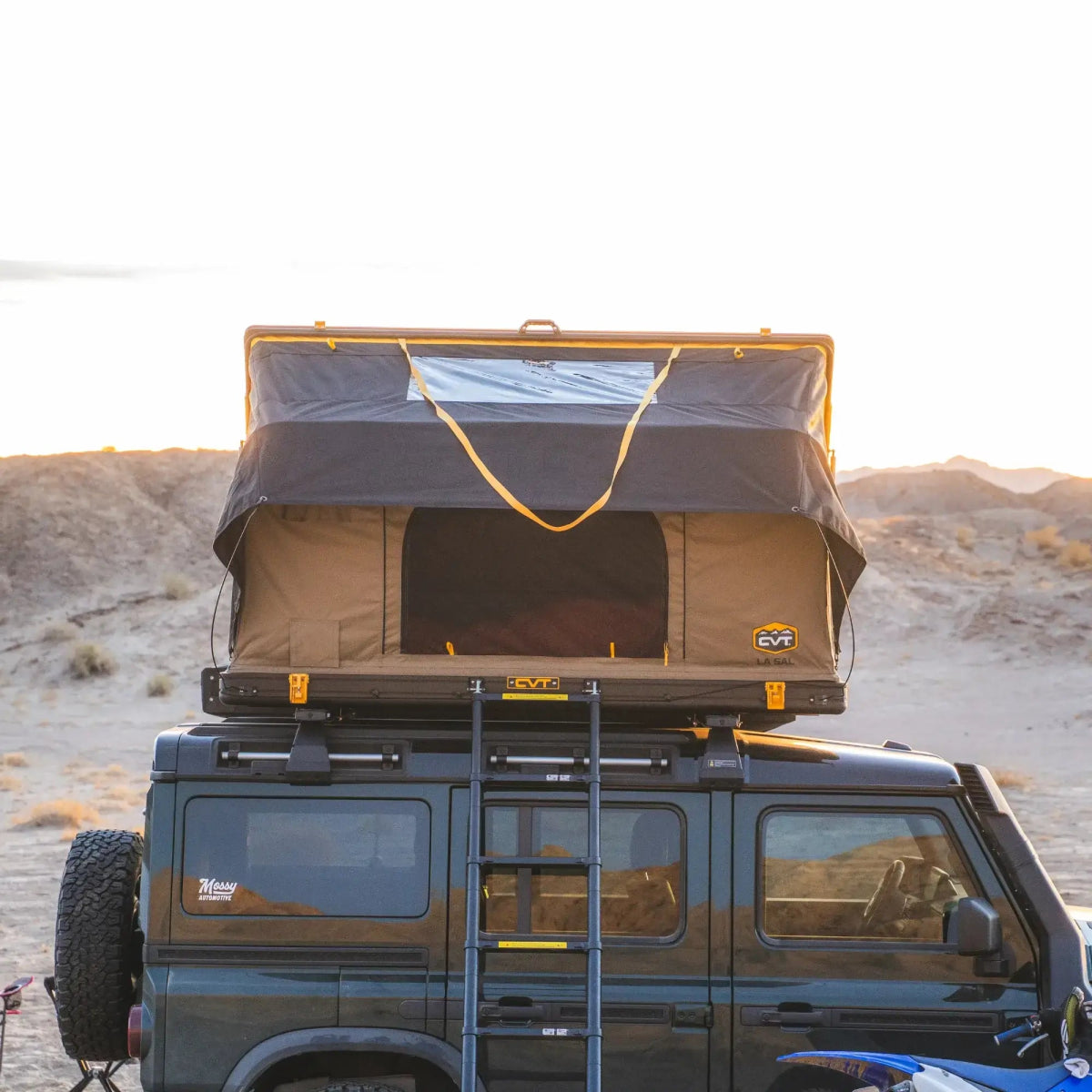
CVT Sandstorm Hard Shell Rooftop Tent
Why We Like It
- Hard-shell ABS top handles snow loads and UV exposure
- Compact footprint fits JL 4-door roof rack without overhang
- 60-second deploy/pack time — critical for frequent camp moves
- Three-season rated; pairs with a liner for 4-season use
- Integrated LED strip lighting and skylight windows
Power & Fridge: Full Solar + Lithium Setup
A Dometic CFX3 55L fridge (~$999) is the expedition standard for capacity and efficiency. Power it with a lithium battery setup (~$1,500) and 200W of solar on the roof rack or hood (~$1,000). A properly wired dual-battery system with a DC-DC charger keeps the house battery topped up while driving without draining your start battery. This full solar and lithium budget (~$2,500) covers everything from the battery box to the wiring harness to the solar controller.
Check Dometic CFX3 55 on Amazon ↗Complete the camp setup with a Gobi Stealth roof rack (~$800) for RTT and solar mounting. The Gobi is the benchmark Wrangler rack — bomber construction, proper drainage, and a mounting system that doesn't loosen under vibration.
Tier 3 Total: ~$22,000–$26,000 — Synergy 4" lift ($3,000) + 37" KM3 tires + Method wheels ($2,400) + ARB lockers installed ($3,000) + full belly skids ($2,000) + AEV front/rear bumpers ($3,000) + Gobi rack ($800) + CVT Sandstorm RTT ($2,999) + Dometic CFX3 ($999) + solar/lithium setup ($2,500) + miscellaneous ($500).
JK vs JL: Which Wrangler to Build?
| Category | JK (2007–2018) | JL (2018–present) |
|---|---|---|
| Purchase Price (used) | Lower — more build budget | Higher — less leftover |
| Highway MPG | 17–19 mpg (3.8L/3.6L) | 20–24 mpg (2.0T/3.6L) |
| Aftermarket | Massive — 10+ years of parts | Large and growing |
| Axle Strength (Rubicon) | Dana 44 front and rear | Dana 44 front + AdvanTEK rear |
| Technology | Older infotainment, simpler electronics | Modern UConnect, Apple CarPlay |
| Safety Ratings | Moderate | Improved crash ratings |
| Best For | Budget builds, dedicated trail rigs | Daily drivers, expedition builds |
The bottom line: if you're buying specifically to build a trail rig on a budget, a clean JK Rubicon is often the smarter purchase. The massive aftermarket means lower parts costs, the Dana 44s are already there, and you can put the saved purchase price into the build. If you want a daily driver that also does trails, the JL's improved fuel economy, modern features, and better highway manners make it worth the premium.
33s vs 35s vs 37s — The Wrangler Tire Guide
33" tires (255/75R17 or 285/70R17): Fit stock or mildly lifted JK/JL Wranglers without rubbing. Best choice for daily drivers who do occasional trails — minimal fuel economy penalty, no driveline stress, and stock wheels are fine. Most Rubicons can fit 33s from the factory. For casual overlanding, 33s are entirely adequate.
35" tires (315/70R17 or 35x12.50R17): The sweet spot for most serious overlanders. Require 2.5"–3.5" of lift for good clearance. Fit the factory Dana 44 axle shafts without undue stress. Meaningfully better flotation in sand and mud than 33s. Minor gearing consideration — most builds at 35s will want a re-gear to 4.56 or 4.88 to restore highway RPM and towing capacity. The 35" BFG KO2 and KM3 are both excellent in this size.
37" tires (37x12.50R17): For serious wheelers only. Require 4"+ of lift and front fender trimming on most JL trims. The additional unsprung weight and rotational mass puts stress on factory axle shafts — budget for upgraded shafts or an axle swap if you're running 37s hard. Re-gearing to 5.13 is strongly recommended. The capability gain over 35s is real on rock and deep mud, but the daily driving compromise is significant. Best matched to a dedicated trail rig rather than a daily driver.
Wrangler Overland FAQ
JK vs JL for overlanding — which should I buy?
Both are excellent. For a dedicated trail rig on a budget, a JK Rubicon (2012–2018 for the 3.6L Pentastar engine) offers Dana 44 axles, factory lockers, and a mature aftermarket at a price that leaves room in the budget for meaningful modifications. For a daily driver that also overlands, the JL's better fuel economy, modern technology, and improved highway manners make it the better long-term vehicle. The JL also benefits from improved crash safety ratings. If budget isn't a constraint, build a JL — it's the better all-around vehicle. If budget matters, a clean JK Rubicon with low miles is one of the best values in the used overlanding market.
Is the Wrangler good for highway driving?
Better than its reputation, but honestly not great. The aerodynamic drag of the upright windshield and boxy shape means fuel economy suffers at highway speeds, and when you add a roof rack or RTT it gets noticeably worse. High-profile tires amplify road noise. That said, a well-maintained Wrangler on quality all-terrain tires is perfectly comfortable at 70 mph — it just costs more to get there than a car or crossover. The JL with the 2.0T four-cylinder or the diesel option improves highway efficiency substantially. If long highway miles are a major part of your use case, consider whether a body-on-frame truck platform might serve you better overall.
Best tires for overlanding on a Wrangler?
For all-terrain use (trails plus daily driving): BFGoodrich All-Terrain T/A KO2. It's the benchmark AT tire — excellent dry and wet road manners, respectable off-road performance in mud and rock, and a 50,000-mile treadwear warranty. For mixed-terrain expedition use: BFGoodrich Mud-Terrain T/A KM3. More aggressive tread, 3-ply sidewall, and real mud performance at the cost of more highway noise and slightly higher rolling resistance. For dedicated rock crawling or deep mud: Falken Wildpeak MT or Toyo Open Country MT — excellent compound, strong sidewalls, and competitive pricing versus BFG.
Reader Reviews
Share your experience with this gear