
📋 Table of Contents
- Why a Winch Is Your Most Important Recovery Tool
- Best Overall: Warn ZEON 10-S
- Best Premium: WARN VR EVO 12-S
- Best Budget: Smittybilt X2O 10,000 lb
- Best for Full-Size Trucks: Warn VR EVO 12-S
- Mid-Budget Alternative: Rugged Ridge Trekker
- How to Pick the Right Winch
- Synthetic Rope vs. Wire Rope
- Winch Mounting Options
- Winch FAQ
Compare the Top Picks
Prices and offer details appear only after a fresh Amazon catalog refresh.
| Product | Key spec(s) | Price | Buy |
|---|---|---|---|
| Warn VR EVO 12-S Winch | 12,000 lb capacity — correctly sized for loaded F-150, Tundra, and Land Cruiser rigs | Check Price on Amazon | |
| Smittybilt X2O 10,000 lb Waterproof Winch | IP68 waterproof — genuinely submersible, not just splash-resistant | Check Price on Amazon | |
| Warn VR EVO 12-S Winch | 12,000 lb capacity — correctly sized for loaded F-150, Tundra, Land Cruiser | Check Price on Amazon | |
| Rugged Ridge Trekker 10,500 lb Winch | 3-stage planetary gear train at mid-budget price | Check Price on Amazon |
Why a Winch Is Your Most Important Recovery Tool
Ask any experienced solo overlander what single piece of gear they'd never leave home without, and the answer is almost always the same: a winch. Recovery boards get you unstuck from sand and shallow mud. A kinetic rope saves you when a buddy is nearby. But when you're axle-deep in a remote bog at dusk with no cell signal and no one within radio range, the winch is the only thing standing between you and a very bad night.
The calculus is simple: recovery boards cost $200, a kinetic rope costs $90, a winch costs $400–$1,100. But the winch handles scenarios that boards and ropes simply cannot — steep downhill slides, solo extractions when you're thoroughly buried, and vehicle-over-obstacle situations where no amount of traction aid will help. If you only buy one dedicated recovery tool for solo travel, make it a winch.
Over three months, we mounted and pulled with eight winches across three different vehicles — a Toyota Tacoma, a Ford Bronco, and a Chevy Silverado — in conditions ranging from Sonoran desert sand to high-alpine mud season and a Colorado rock trail. Here's everything we learned.
1. Warn ZEON 10-S — Best Overall
The Warn ZEON 10-S has become the default recommendation for mid-size truck and SUV owners for good reason. The series-wound motor — the same type used in Warn's much pricier ZEON line — delivers consistent pulling power even when the motor is hot and the load is sustained. In our mud extraction tests, it never stuttered or overheated during multi-stage pulls that took 8–12 minutes of intermittent operation.
The synthetic rope that ships with the 10-S is a genuine upgrade over the steel cable that came standard on older Warn models. It's lighter, floats in water, and — critically — doesn't store the dangerous kinetic energy that wire rope does if it snaps. After 60+ pulls across all terrain types, the rope showed minimal surface abrasion and no structural degradation.
Warn's dealer network matters more than most buyers realize. When the roller fairlead on our test unit developed a slight roughness after a particularly rocky extraction, a Warn dealer had us a replacement part within two days. That kind of support is worth real money over the life of a winch.
2. WARN VR EVO 12-S — Best Premium
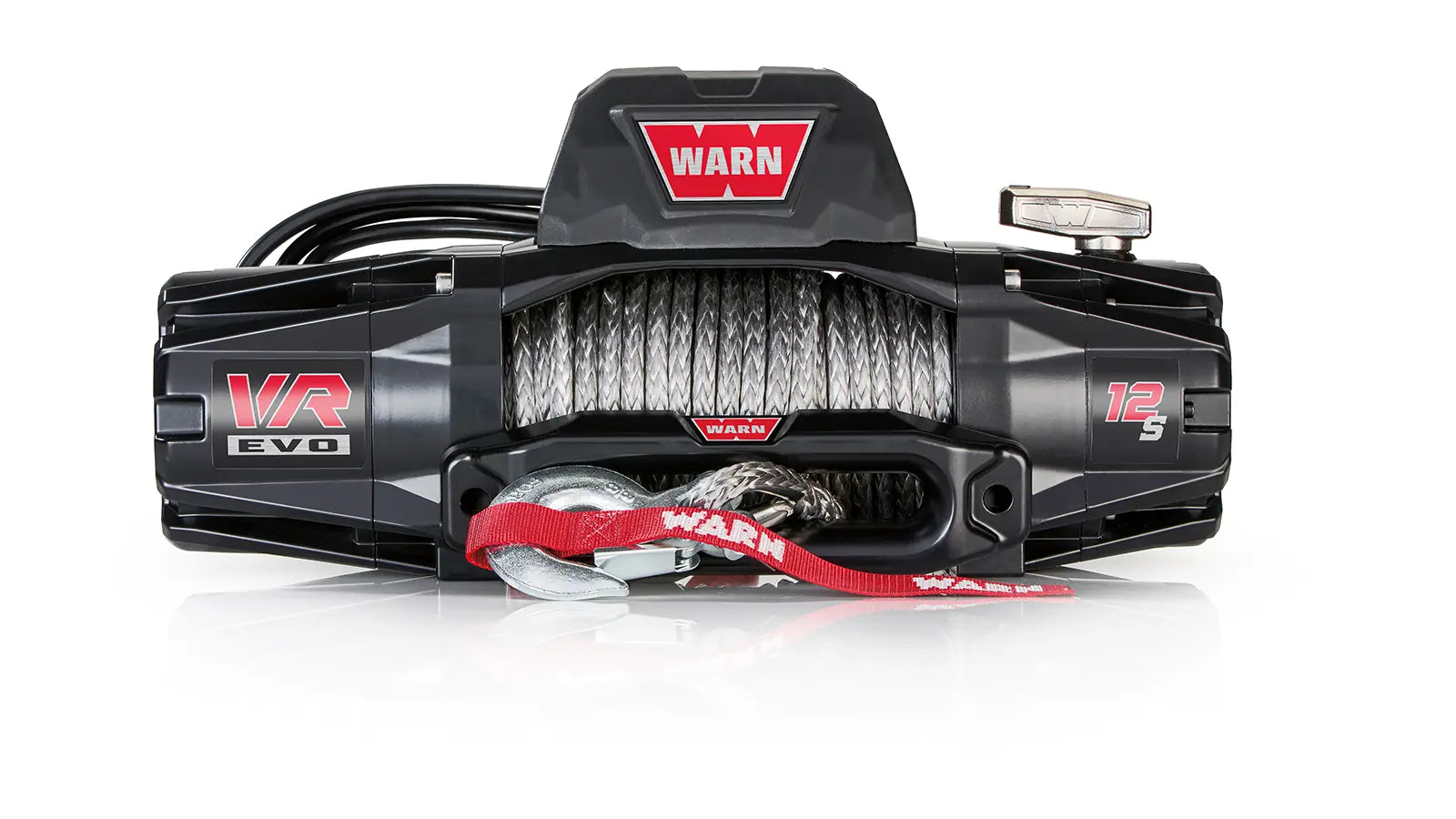
Warn VR EVO 12-S Winch
Why We Like It
- 12,000 lb capacity — correctly sized for loaded F-150, Tundra, and Land Cruiser rigs
- Synthetic rope, IP68 waterproofing, and a series-wound motor
- Warn warranty and dealer support at full-size scale
- Extra capacity headroom for sustained, real-world recovery loads
The WARN VR EVO 12-S is the premium-capacity choice in this comparison for overlanders running a loaded full-size truck or a heavy expedition SUV. Its 12,000 lb rating provides meaningful headroom when mud suction, slope grade, and vehicle weight push a recovery beyond the needs of a 10,000 lb setup.
It keeps the Warn support network and synthetic-rope, waterproofing, and series-wound-motor combination described in the comparison table. For a heavier rig where capacity margin matters more than the compact 10K format, the VR EVO 12-S is the distinct premium pick.
3. Smittybilt X2O 10,000 lb — Best Budget
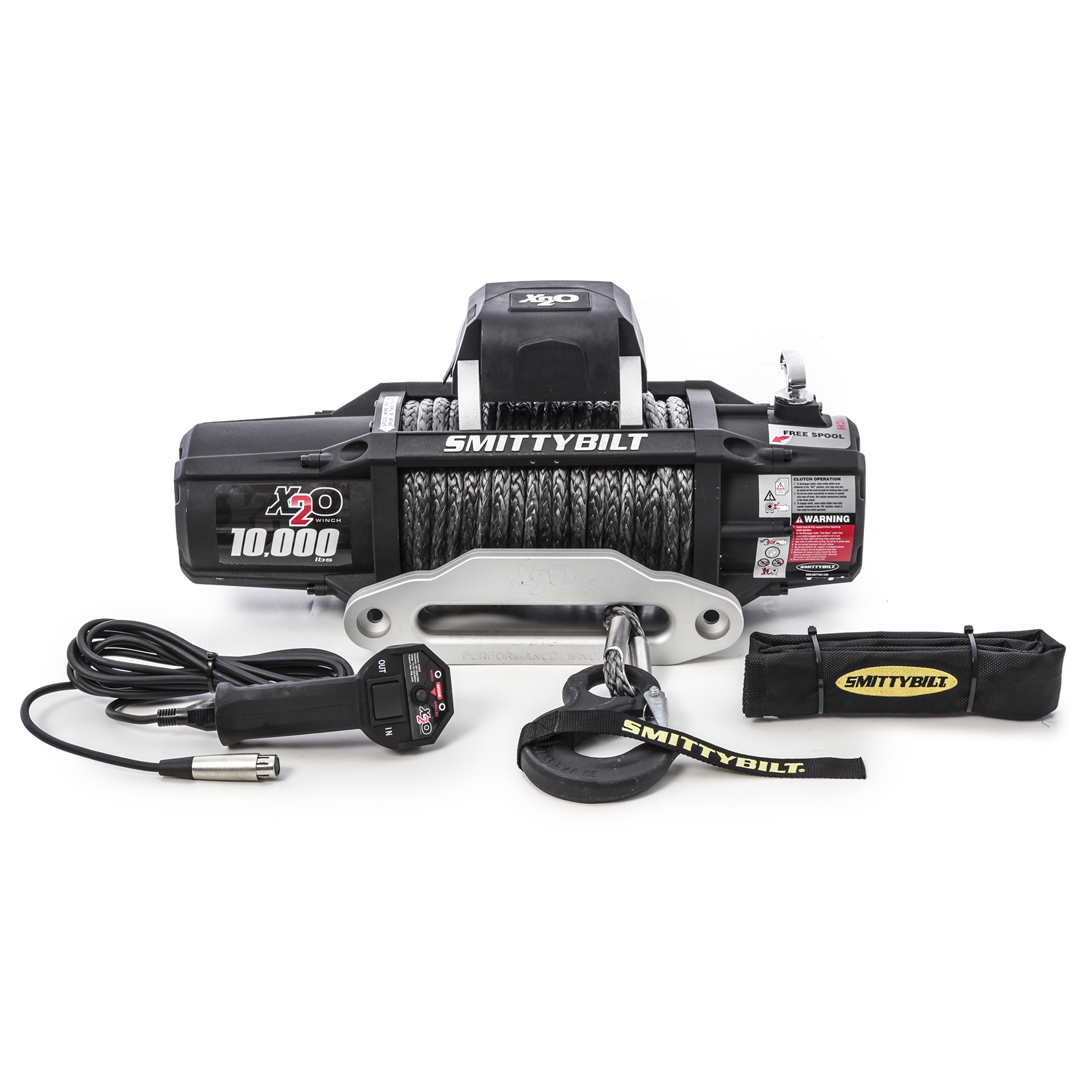
Smittybilt X2O 10,000 lb Waterproof Winch
Why We Like It
- IP68 waterproof — genuinely submersible, not just splash-resistant
- Synthetic rope included at this price point
- 10,000 lb capacity handles mid-size trucks and SUVs
- Wireless remote included — useful for solo recovery setup
- Remarkable value for occasional-use overlanders
We'll be honest: we expected to dismiss the Smittybilt X2O. At $399 with synthetic rope included — a feature that adds cost even at Warn — it looked too good on paper. In practice, it performed respectably for weekend-warrior use. Single-stage recoveries went without issue. The IP68 waterproofing is legitimate; we drove it through a stream crossing and it performed fine afterward.
The limitation becomes clear under sustained load. On a particularly stubborn mud extraction that required three minutes of continuous pull, the motor ran noticeably hot. The X2O has less thermal mass than the Warn units, and it communicates its temperature limits more aggressively. For overlanders who get stuck occasionally and have time to work methodically, it's excellent value. For technical wheelers who may need rapid consecutive pulls, step up to the VR EVO.
4. Warn VR EVO 12-S — Best for Full-Size Trucks
Warn VR EVO 12-S Winch
Why We Like It
- 12,000 lb capacity — correctly sized for loaded F-150, Tundra, Land Cruiser
- All the same VR EVO quality at larger capacity
- Synthetic rope, IP68 waterproofing, series-wound motor
- Handles the real-world weight of a fully loaded expedition rig
- Warn warranty and dealer support applies at full-size scale
If you're running a full-size truck — F-150, Ram 1500, Tundra, Land Cruiser 300 — the 10,000 lb VR EVO is undersized. A loaded full-size expedition rig easily weighs 6,000–7,500 lbs, and the 1.5x vehicle weight rule puts the minimum winch capacity at 9,000–11,250 lbs. Under real extraction conditions, where you factor in mud suction, slope grade, and the dynamic load of a buried vehicle, the 12-S's extra headroom becomes meaningful. This is the same winch as the 10-S with a bigger motor and longer rope — there's no penalty in build quality or features for sizing up.
5. Rugged Ridge Trekker 10,500 lb — Mid-Budget Alternative
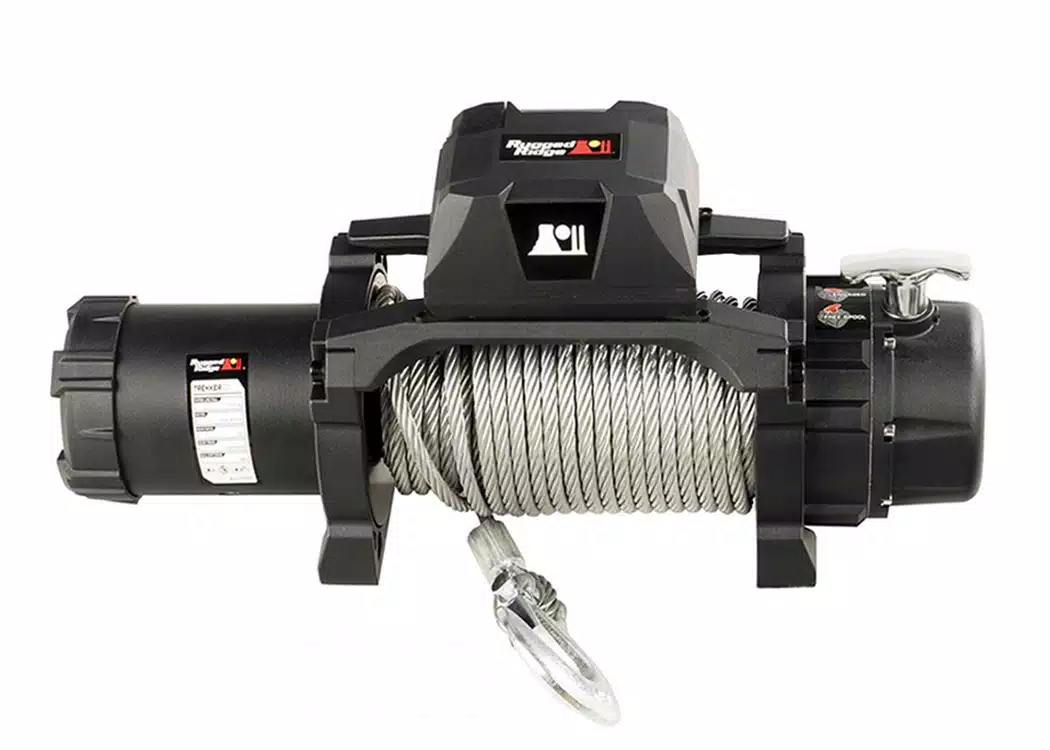
Rugged Ridge Trekker 10,500 lb Winch
Why We Like It
- 3-stage planetary gear train at mid-budget price
- Synthetic rope included
- 10,500 lb capacity with slight headroom over 10K units
- Solid motor with acceptable heat management
- Good alternative when Smittybilt inventory is limited
The Rugged Ridge Trekker slots between the Smittybilt and the Warn VR EVO in both price and performance. The 3-stage planetary gear train is a meaningful upgrade over the Smittybilt's series-wound motor — quieter, more efficient, and slightly better heat behavior. If the Smittybilt is out of stock or you want a modest step up without committing to Warn money, the Trekker is a reasonable choice. It's not as proven as the Warn line and the dealer support network is thinner, but it performed reliably across our test pulls.
How to Pick the Right Winch Capacity
The industry standard is the 1.5x vehicle weight rule: your winch should be rated for at least 1.5 times your vehicle's gross vehicle weight (GVW) when loaded for a trip. Here's how that math works in practice:
- Toyota Tacoma (loaded): ~5,000 lb GVW → minimum 7,500 lb winch → 10,000 lb is the right choice
- Ford Bronco (loaded): ~5,200 lb GVW → minimum 7,800 lb → 10,000 lb fits
- Ford F-150 (loaded expedition): ~6,500–7,500 lb → minimum 9,750–11,250 lb → 12,000 lb is the right choice
- Land Cruiser 300 (fully loaded): ~7,000+ lb → minimum 10,500 lb → 12,000 lb or 12,500 lb
The 1.5x factor accounts for real-world conditions — mud suction can add 25–50% to the effective resistance of a stuck vehicle, and a slope multiplies required force further. Don't cheap out on capacity; bigger winches run cooler and last longer even when they're not being maxed out.
Synthetic Rope vs. Wire Rope
If you're buying a new winch in 2026, buy synthetic rope. The debate has been settled. Here's why:
- Safety: A snapping wire rope stores enormous kinetic energy and recoils with potentially lethal force. Synthetic rope drops to the ground when it fails — still not something you want near people, but far safer.
- Weight: Synthetic rope is significantly lighter, which matters when you're mounting the winch at the front of the vehicle (ahead of the front axle).
- Handling: Wire rope develops burrs and kinks that cut hands even through heavy gloves. Synthetic rope is safe to handle barehanded.
- Floats: In water crossings, synthetic rope floats and won't kink on the bottom.
The only real advantage of wire rope is abrasion resistance on jagged rock. If you're doing technical rock crawling where the rope regularly contacts sharp edges, consider a hawse fairlead cover and rope sleeve. Otherwise, synthetic is the right choice.
Winch Mounting Options
Most winches mount to a winch plate on the front bumper. Your options:
- Aftermarket steel bumper with integrated winch plate: The gold standard. Bumpers from ARB, Warn, Ironman 4x4, and similar brands have purpose-built winch cradles with proper load paths. Bolt the winch in and you're done.
- Hidden winch mount (hitch receiver style): Mounts to the receiver hitch — front or rear — and stores in the bed when not in use. Good for trucks where you don't want a permanent front bumper. Less ideal for solo recovery since you need time to set it up.
- OEM bumper winch plate: Some factory bumpers (Bronco, some Tacoma packages) have integrated winch mounts. Check load ratings carefully — not all OEM mounts are rated for serious recovery forces.
Whatever mount you use, verify the connection between the winch, mount, and frame is engineered for recovery loads — not just the winch's rated pull, but the dynamic shock loads that happen in real extractions. This is the most common failure point we see on trail.
Winch FAQ
How big a winch do I need?
Use the 1.5x rule: multiply your loaded vehicle weight by 1.5 to get your minimum winch rating. A loaded mid-size truck or SUV (Tacoma, 4Runner, Bronco, Wrangler) typically needs a 10,000 lb winch. A loaded full-size (F-150, Tundra, Land Cruiser) needs 12,000 lb or more. When in doubt, size up — a bigger winch runs cooler and lasts longer.
Synthetic rope vs. wire rope — which is safer?
Synthetic rope is safer in nearly every scenario. When wire rope fails under tension it stores and releases kinetic energy with potentially lethal force; synthetic rope falls to the ground. Synthetic is also lighter, doesn't develop sharp burrs, and floats in water. The only advantage of wire is abrasion resistance on jagged rock — use a rope sleeve if you're concerned about that. Buy synthetic.
Can I use a winch without a steel bumper?
Yes, with caveats. Some factory bumpers have engineered winch mounts — the Ford Bronco and some Tacoma packages include them. Hidden hitch-mount winch systems also work well for occasional use. The key requirement is that whatever the winch is bolted to must be rated to transfer recovery forces to the frame. Never use a winch bolted to an unrated plastic bumper or tow hook — the anchor point, not the winch, is typically what fails.
Reader Reviews
Share your experience with this gear